





How a three-day getaway on a Saronic Gulf island turned into a «different» exploration among centuries-old olive groves, ancient sanctuaries and Byzantine castle towns.
There are places you know because you've visited them many times. And there are places you know because you grew up within them. For me, Aegina belongs to the second category.
Our house there is from my great-great-grandmother. So, from as far back as I can remember almost up to adulthood (the formal kind, because I'm still waiting for the real thing), my life was arbitrarily split into two seasons: a grey winter, from which I remember almost nothing, and a summer on Aegina, flooded with images and memories.


I remember walks that seemed endless back then and friends I met every summer, as if not a single day had passed since the previous one. Spontaneous night swims (usually in our clothes or underwear), open-air cinemas after endless arguments about which film to watch (Aegina has four wonderful open-air cinemas — three in town and one in Agia Marina), riding two or three to a bicycle, conspiracies with my brother for every kind of mischief and, of course, the first romances. There, on the low wall at the back side of the little chapel of St. Nicholas the Seafarer, where a kiss felt like a secret mission and being seen by one of the "grown-ups" was almost the worst thing that could happen to you.


I remember Aegina the way one remembers the summers of their childhood and teenage years: not as a tourist destination with sights, beaches, and villages, but as a series of small, bright scenes etched forever on the soul.
And yet, this year, returning for Fistiki Fest, I realized something strange. I've visited Aegina hundreds — perhaps even thousands — of times, if you count the back-to-back weekends from early March to late November. I grew up here. I've walked and driven on almost every road, I've swum in its seas, I've stayed out late in its alleyways. And yet, there are pieces of it I don't remember ever seeing.
Maybe because, when you grow up in a place, you neither look at it nor truly search it. You take it for granted. You know where you'll go for a swim, where you'll eat, which way you'll pass to get home. You don't seek out its history, you don't observe its paths, you don't wonder what's just beyond the usual route.
This time, then, spurred by Fistiki Fest and with two good friends — Zoi and Evi — I decided to do something different: to go to Aegina and, besides of course enjoying the traditional pistachio festival, to discover whatever I don't remember having seen.
Arrival... with a twist
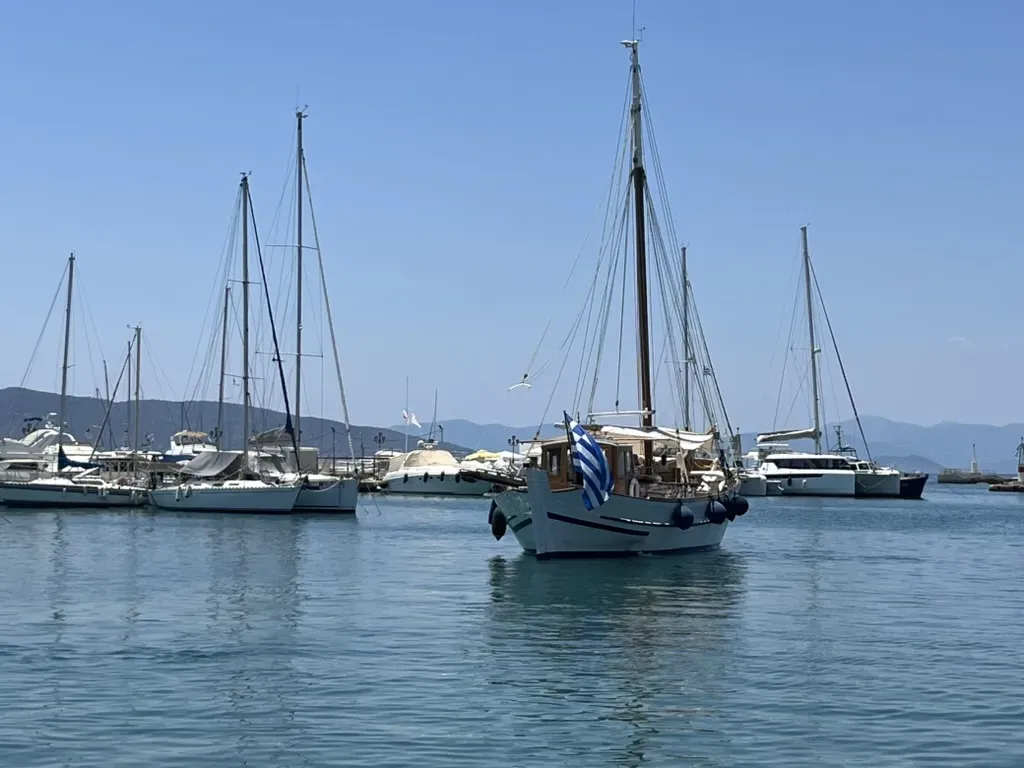
This time we even skipped the usual ferries. We left from the Nautical Club of Amfithea on my brother's boat, "Panagia Tinou", a traditional, historic caique and a work of art in its own right, as it was built in 1953 on Syros by Nireas Mavrikos. How different it is to travel like this! Without the rush and queues at the port of Piraeus, with the open sea around you, Athens slowly receding and Aegina revealing itself bit by bit.
Just before we moored, we took a dip in the crystalline waters off Kolona — the essential "baptism" before setting foot on my favorite island. Swimming there, you lift your gaze to the hill and see the only remnant still standing: an imposing Doric column. It's what's left of the magnificent Temple of Apollo, built in the late 6th century BC (around 520–510 BC) — roughly seven decades before the Parthenon.
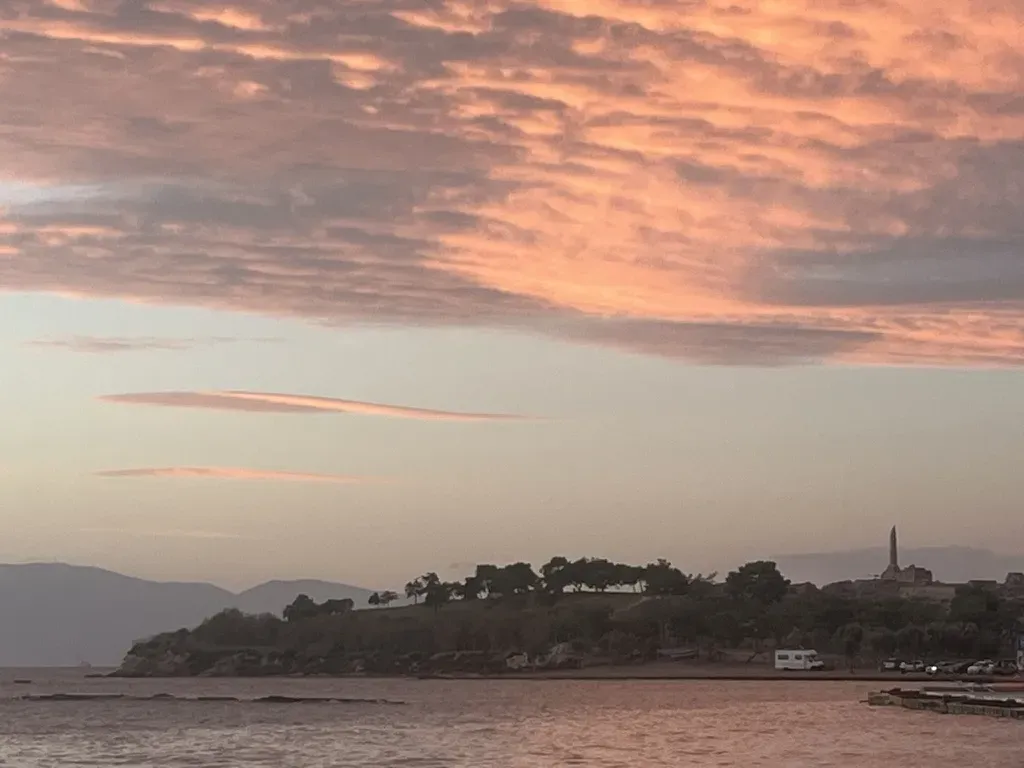
In your mind, you try to reassemble the image of the island's ancient Acropolis. This hill was the political, religious, and fortified center of Aegina continuously since prehistoric times (3000 BC). Here stretched the mighty ancient city with its walls and its military harbor (the famous "Kryptos Limenas"), at a time when Aegina was a dominant thalassocratic power.
It was also one of the most important centers of ancient Greek coinage, with its famed silver coins bearing the turtle — a symbol that became deeply intertwined with the island's history and identity. This single column that has survived today and gave the area its name from the Venetian sailors who used it as a navigational marker stands there to remind you of the Saronic's eternal grandeur.


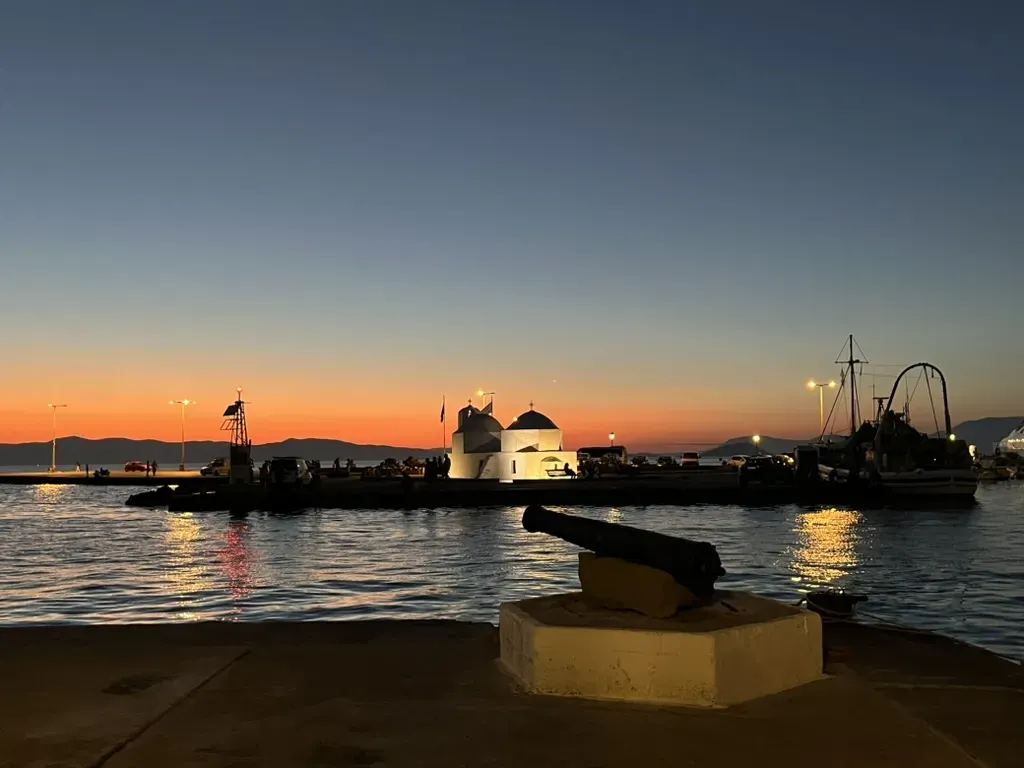
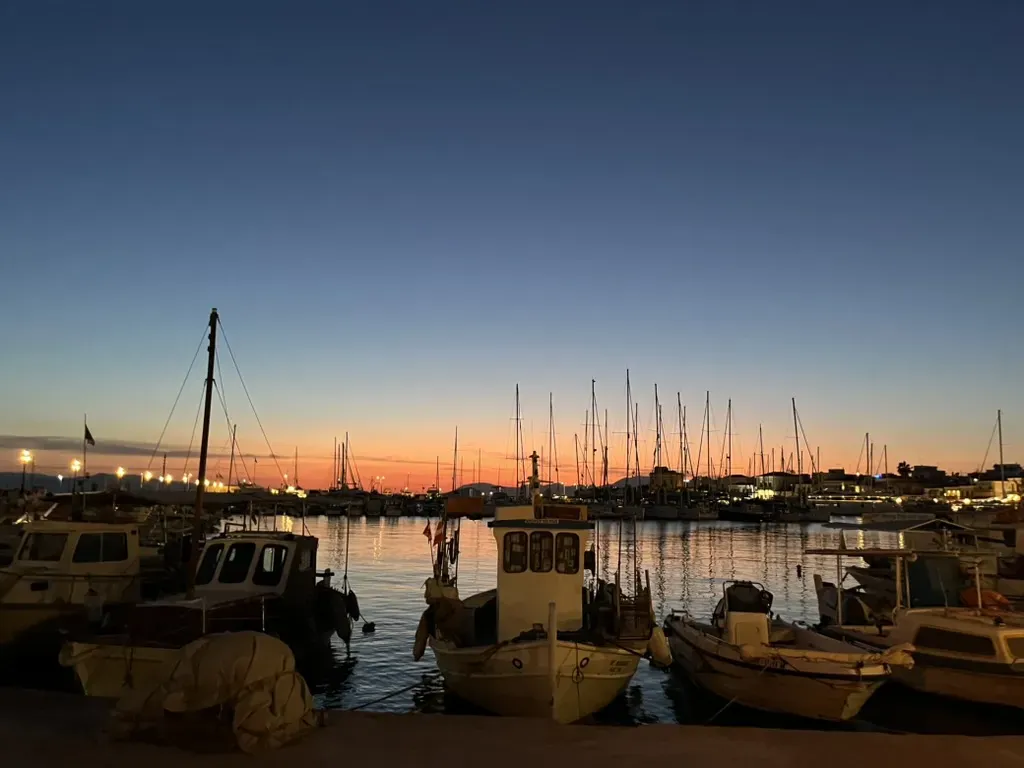
After this "historic" dip, we headed to the main port to moor. Entering, you're reminded again why you love this place. The little chapel of St. Nicholas the Seafarer beside the lighthouse (yes, the one whose back side has sheltered the first heartbeats of many generations), the iconic "Gate" by Kostas Varotsos welcoming visitors, the wonderful neoclassical buildings in a row, all compose one of the most distinguished harbors of the Argosaronic. We tied up just next to Nektarios's fruit caique — right in the heart of the action.
The celebration of Fistiki Fest


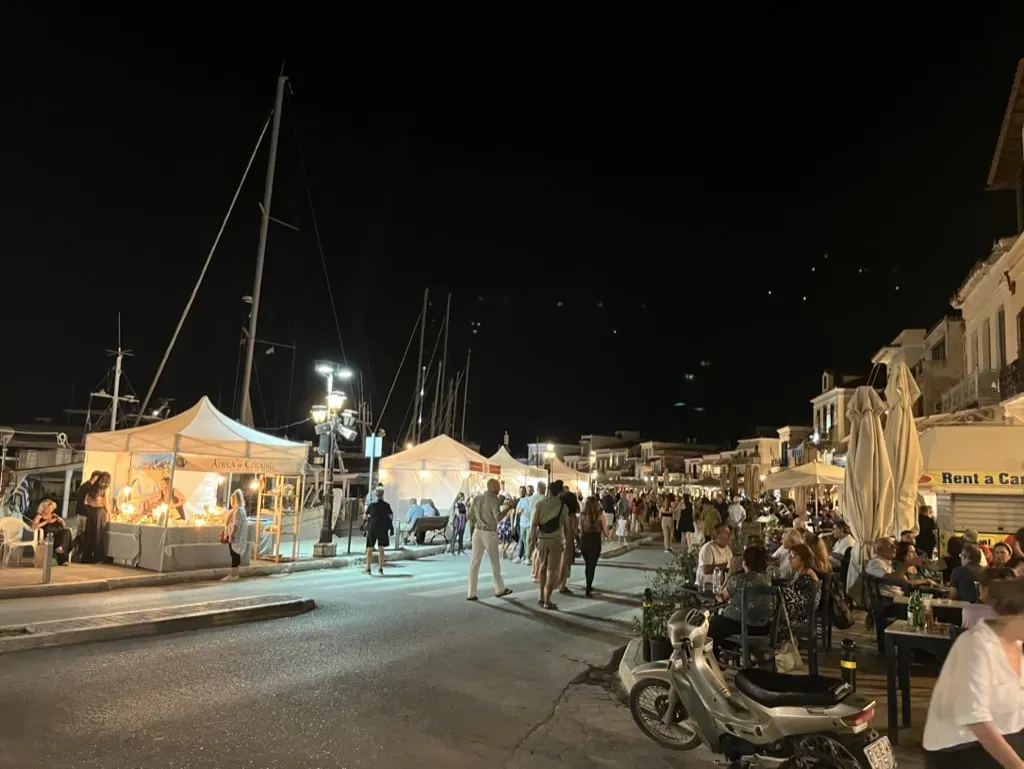
The port was already dressed for the occasion. Fistiki Fest isn't just a trade fair; it's a vibrant, multi-faceted celebration that takes over the entire seafront promenade. Tents and wooden stalls brimming with every kind of creation, mostly based on Aegina's famed pistachio: from classic freshly roasted nuts and fragrant pistachio butter, to handmade sweets, pistachio pesto, liqueur, ice cream of course, and even cosmetics and jewelry.
My friend Giorgos, who's more "local" than I am — given that he went to school on the island — came and found us at the permanent booth of "Dionysos", where Zois prepared our bags with the top products one can take away. Naturally, the shopping doesn't stop only at the seafront stands, as the inner streets and alleys hide lovely little shops with all kinds of fine wares.


Of course, Fistiki Fest isn't only food and shopping. It's a whole cultural pulse that spreads everywhere. Alongside the market, art exhibitions are set up at emblematic spots such as the Historical & Folklore Museum and the Municipal Gallery, while the streets fill with children's smiles thanks to special activities — from pastry-making workshops and face painting, to seafaring challenges organized by the Nautical Club.
As for the evenings, music took center stage. The highlight was undoubtedly Saturday's concert with Eleonora Zouganeli. On the stage set by the waves, in front of St. Nicholas the Seafarer, her voice swept the crowd beneath the starry sky, creating a one-of-a-kind atmosphere.
Every year, Fistiki Fest proves it's not just celebrating a nut, but the very creativity, vitality, and hospitality of this place.
Discovering the "other" Aegina
But our mission this year didn't stop at the port. We left behind the festive oasis and set out to discover the Aegina of tranquility, nature, and age-old history.
It's a fact that Aegina has countless ways to captivate you. Its history begins long before the images we hold in our minds today, reaching back into mythology. According to tradition, Zeus fell in love with Aegina, daughter of the river god Asopos, took her with him and brought her to the island then called Oinone. From her it took its present name.
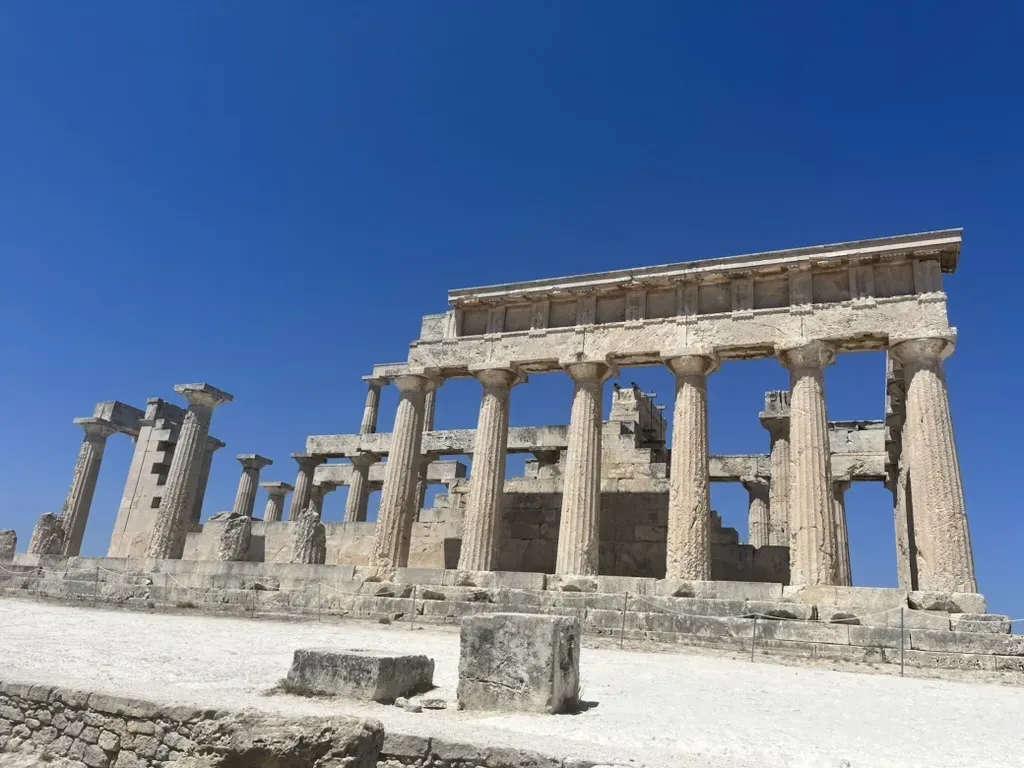
The Temple of Aphaia, with its commanding Doric order and striking position on a pine-clad hill overlooking Agia Marina, is one of antiquity's most important monuments. Built around 500–490 BC, its proportions and architectural solutions are thought to have influenced later classical temple-building, among others the Parthenon. Together with the Parthenon and the Temple of Poseidon at Sounio it forms antiquity's famed notional "sacred triangle". The temple is dedicated to the local goddess Aphaia, the "vanished" nymph who, trying to escape King Minos's amorous pursuit, fled to Aegina and mysteriously disappeared into the island's rocks - leaving behind only her myth and the sacred aura of the landscape. Although the temple's famed marble pediments are now kept far away (at the Glyptothek in Munich), the energy and harmony of the site remain untouched.
Then, heading toward Pachia Rachi, a traditional, preserved settlement with stone mansions, we took the trail at the foot of Mount Ellanio that leads to one of Aegina's most mystical corners: the Ancient Olive Grove. There, centuries-old olive trees — some estimated to be as old as 1,500 years — with huge, spiraling trunks that look like living sculptures, stand as silent witnesses of time. Some trunks are so large that their circumference reaches 13 meters, forming natural "caves" within. Walking among thyme, mastic shrubs, and old stone chapels (such as Agia Kyriaki and Agios Georgios), you feel you're striding through a sacred place that has remained untouched by time, far from any touristic intervention.


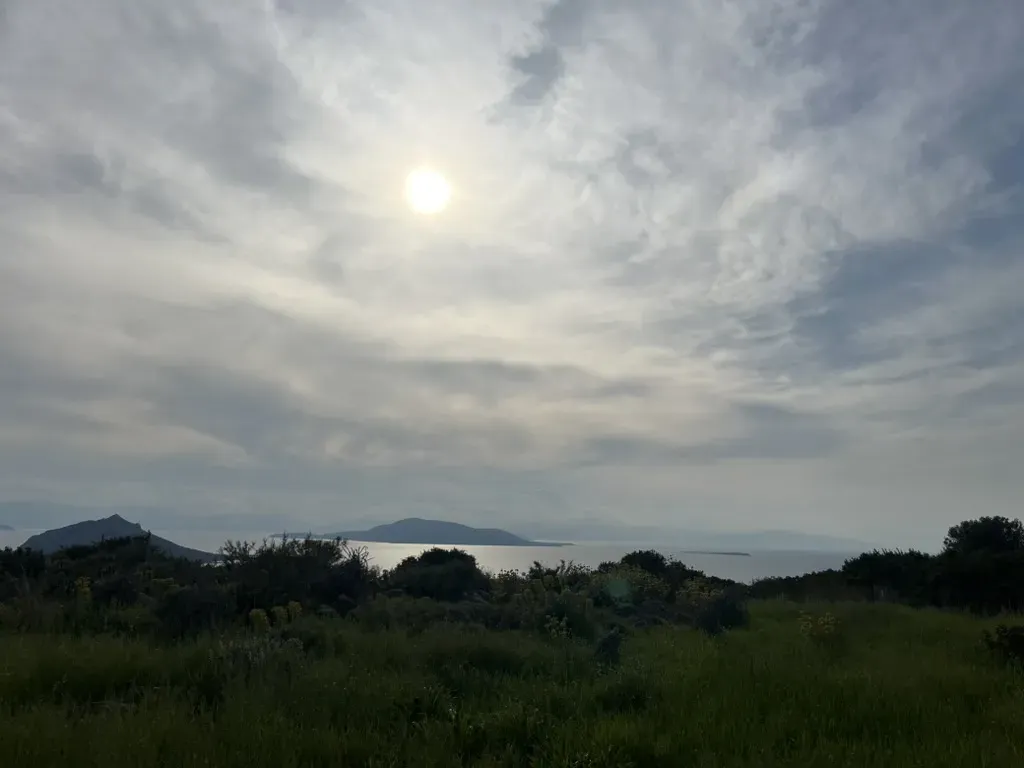
And somewhere higher up, at the summit of Mount Ellanio — "To Oros", as the locals simply call it, which dominates at 532 meters as the highest point in the Saronic — lies the sanctuary of Ellanios Zeus.
According to myth, when a devastating barrenness and drought struck all of Greece, the Greeks asked Aegina's king, Aeacus (son of Zeus and the nymph Aegina), to intercede. Aeacus climbed to the mountain's peak, prayed to his father and he sent the beneficent rains, giving the sanctuary the name of Zeus of all the Greeks. Today, ongoing archaeological research sheds even more light on the site's history — from Minoan and Mycenaean fortifications to the later Doric temple.
A little further on, opposite the imposing monastery of Saint Nektarios, rises the hill of Palaiochora — the "Mystras of Aegina". This is the island's old medieval capital, where from the 9th century and for almost a thousand years the Aeginetans took refuge inland to protect themselves from the ruthless raids of pirates, like the notorious Barbarossa.
Climbing the cobbled lanes amid wildflowers and house ruins, you discover a ghostly castle-town that seems to hover in time. Of the roughly 365 churches said to have once existed — one for every day of the year — about 38 survive today. Many of them are open, hiding inside rare Byzantine frescoes that still withstand the wear of centuries. Reaching the highest point, where the Venetian castle once towered, the silence of the landscape is broken only by the wind, while a panoramic view over the hinterland carries you back to the Argosaronic's Byzantine past.
But Aegina doesn't only bear the weight of its ancient and medieval history; it's marked by a deep spirituality, making it one of the most significant poles of religious tourism in Greece. The first and undisputed stop for thousands of pilgrims is the Holy Monastery of Saint Nektarios, a place of peace and prayer, where the beloved Saint lived and was laid to rest. And of course the island's spiritual map doesn't end there.
Hidden in the heart of Aegina's interior, in a remote and mountainous landscape, stands the historic Monastery of Panagia Chrysoleontissa. Built like a fortress in the 17th century to protect against pirates, she is considered the island's patroness and protector. Chrysoleontissa also owns the beautiful islet of Moni, a lush habitat with crystalline, blue-green waters, where deer and peacocks live freely among pines that reach the shore, enchanting every traveler who arrives by boat from the main port - or even better from Perdika (in less than ten minutes).
Just outside the town of Aegina, you come upon one of the most devout pilgrimages: Panagia Faneromeni. Its special beauty lies in the fact that beneath the present church there hides an underground cave — an ancient catacomb — where the icon of the Virgin was found and where visitors descend the stone steps to light a candle in an atmosphere of pure mystagogy.
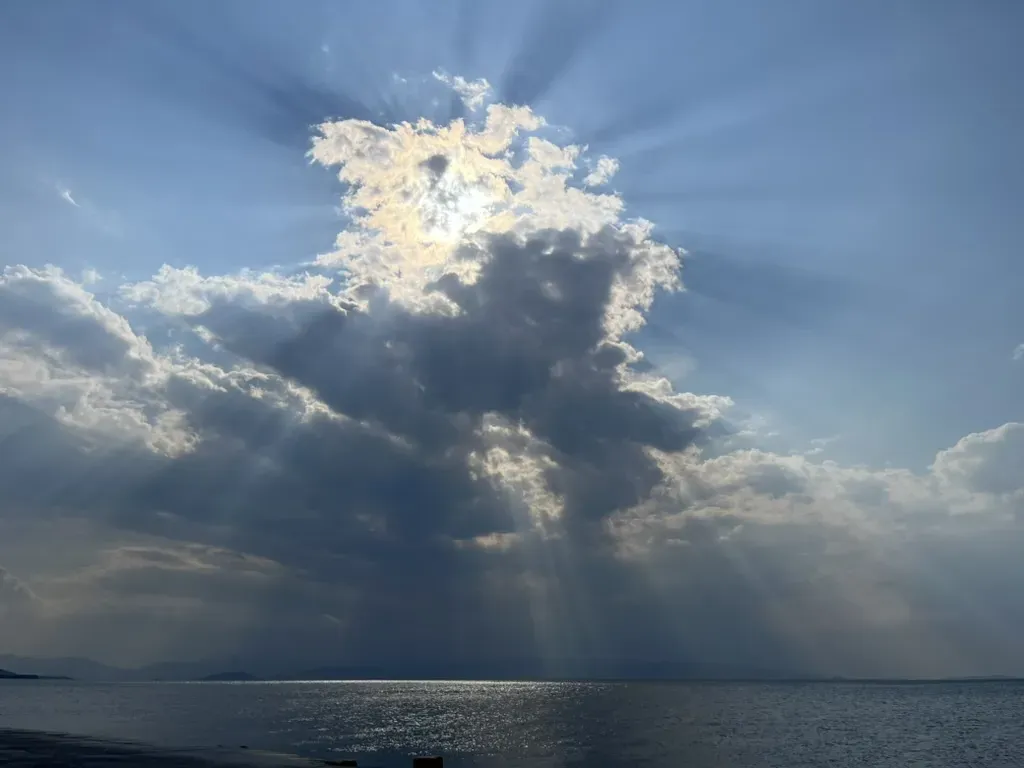
From the secluded mountain monasteries to the seaside chapels and hidden caves, Aegina radiates a unique spirituality that touches you, whatever your reason for visiting.
Aegina, then, isn't just the familiar place of my childhood summers, nor only the nostalgia of carefree years gone by. It's all that and a thousand things more. The light on Aphaia's Doric columns, the silence of the Ancient Olive Grove, the Byzantine cobbles of Palaiochora, the devotion in its monasteries, and the laughter of friends aboard a traditional caique, with a bag of freshly roasted pistachios in hand.
And in the end, perhaps the most important journey isn't the one that takes you to places you've never been before, but the one that brings you back to the places you love and teaches you to look at them with different eyes.
Because, no matter how well you think you know a place, there's always something you haven't noticed. A path you didn't take, an old house you never truly looked at, a story you didn't hear, a landscape that was always there and simply waited for you to stand before it a little longer.
And perhaps that's what's ultimately beautiful about Aegina: that, the more you return, the more it will always have something yet to give you.