





From the mountainous serenity of Pispilounta on Chios and the vibrancy of Çeşme and Bodrum in Turkey, to the wild beauty of Kalymnos - A journey filled with authentic scenes and shifting emotions, against the backdrop of the Aegean.
There are trips you plan around popular guides, the «must» beaches and the sights you absolutely have to see. And there are those that are born almost by chance, maybe from an inexplicable urge to connect a few mismatched dots on the map. My route clearly belongs to the second category.
It began in a small village in Northern Chios, where time seems to have hit "pause". It continued with a dose of cosmopolitan energy on the Asia Minor coast and ended in one of the most atmospheric, magnetic landscapes of the Dodecanese.
A journey full of contrasts: from absolute digital isolation up in the mountains, to the hum of the harbors and then to the bare, almost cinematic beauty of an Aegean landscape. And maybe that's the true meaning of an escape: not just changing place, but, if only for a while, changing your pace of life.
Stop 1: Pispilounta - Hidden in the mountains and in its own space-time
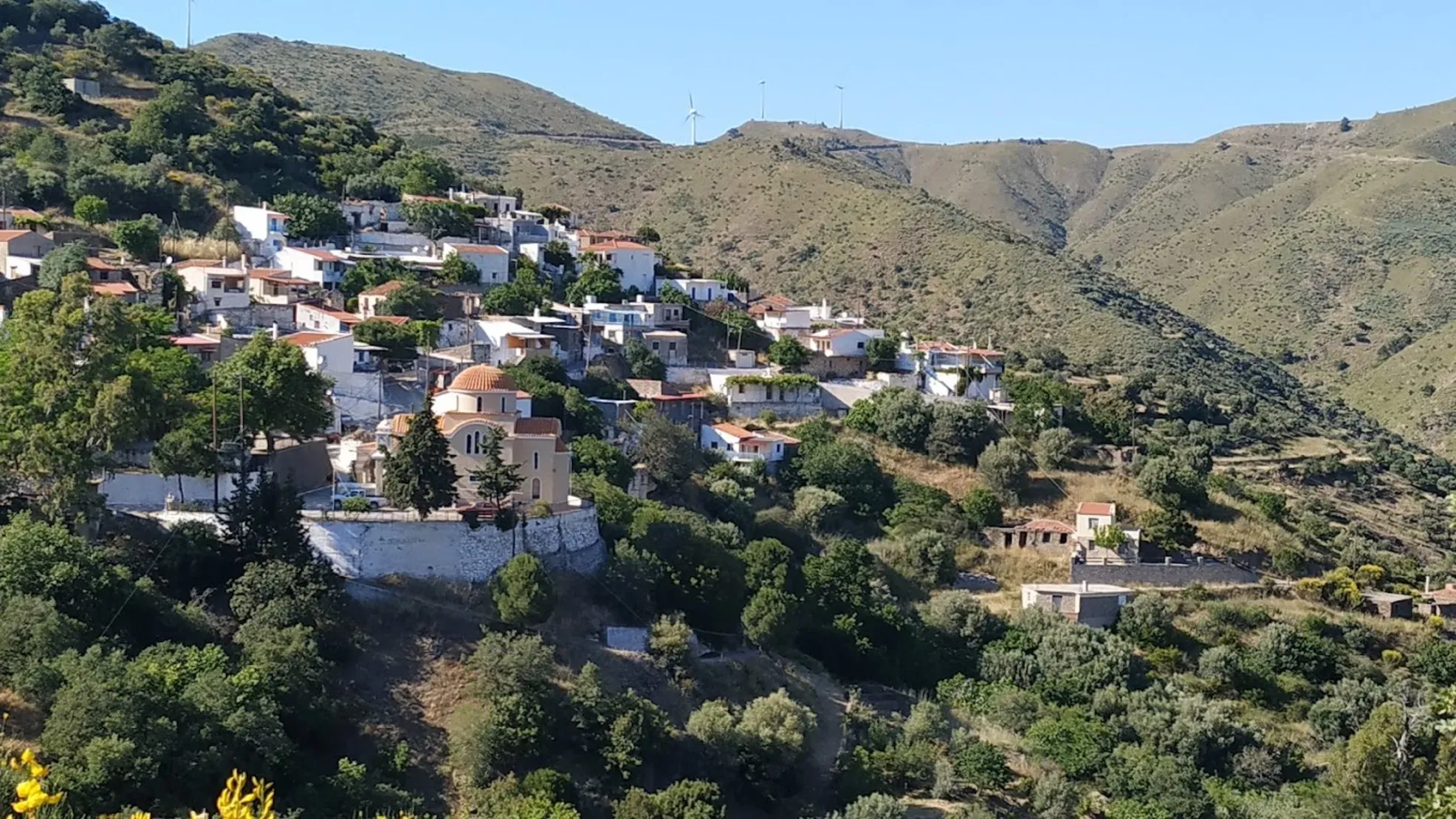
The journey begins with total disconnection. Pispilounta, nestled and almost hidden in the Amani mountains, in Northern Chios, is one of those places that make you forget what day it is. As for the time, not a chance! Even the bell of the village church (Saints Constantine and Helen) seems to have surrendered to oblivion, striking the hour and the half-hour at entirely its own, "wrong" times.
A small, secluded place that seems to have slipped out of modern space-time and to follow other, much slower, otherworldly rules. Here even technology takes a step back. Or, to be precise, it disappears.
The internet is more of a theoretical concept, while the mobile phone is mostly decorative. There is, of course, a single, almost magical exception: sometimes, when a strong north wind blows, the phone decides to cooperate and a faint hint of signal appears. Half a bar, that's all. But in a place like Pispilounta, even that feels like a technological miracle. If the weather doesn't play along, the isolation is absolute. That's why the village's unofficial motto is: No WiFi, no location, Pispilounta Vibration! And that vibration is truly strong and unique.


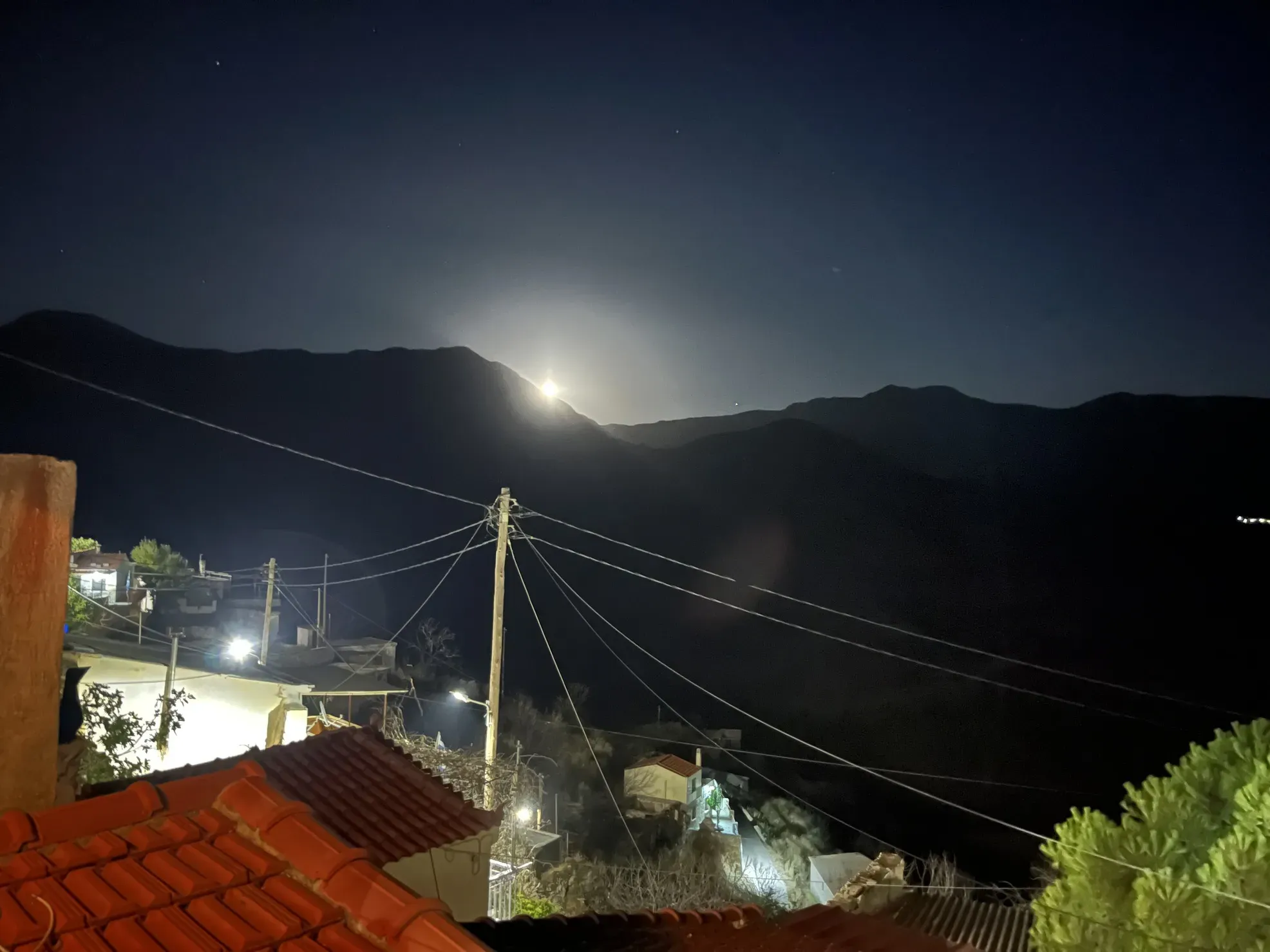
The quiet, the nature, the coolness, the moon rising behind the mountain and lighting the little chapel of Saint Demetrios (the only human addition on the opposite mountain), force you to slow down. You no longer care to look at a screen, because you've started to look around you. You hear again sounds that in the city have been lost in the constant din. You see images that the gray mass of concrete and artificial light have almost erased from your memory. And, without realizing it, you're flooded by that rare feeling that no one expects you to be anywhere, to reply to anything, or to catch up with something.
That's why my friend Dimitris, who hosted me at his home (since, of course, in Pispilounta there are no hotels, nor shops of any kind - only the houses of a few non-permanent residents) calls the village a "carefree park". And it truly is.
The nearby, beautiful Volissos, where you'll go for essential supplies but also for a swim at the wonderful Lampsa, almost feels like plugging back in. But don't imagine, though, that Pispilounta is always a quiet place. For a few days in mid-August, the scene changes completely.
The local cultural association organizes activities that keep tradition alive and bring people from all over Chios: events for the local dialect, the almond festival and, of course, the big feast of August 15th. On that day Pispilounta puts on its festive dress. The main square fills with people, the bands take their places, island tunes set the rhythm and the traditional Chian goat pilaf has its moment of honor.
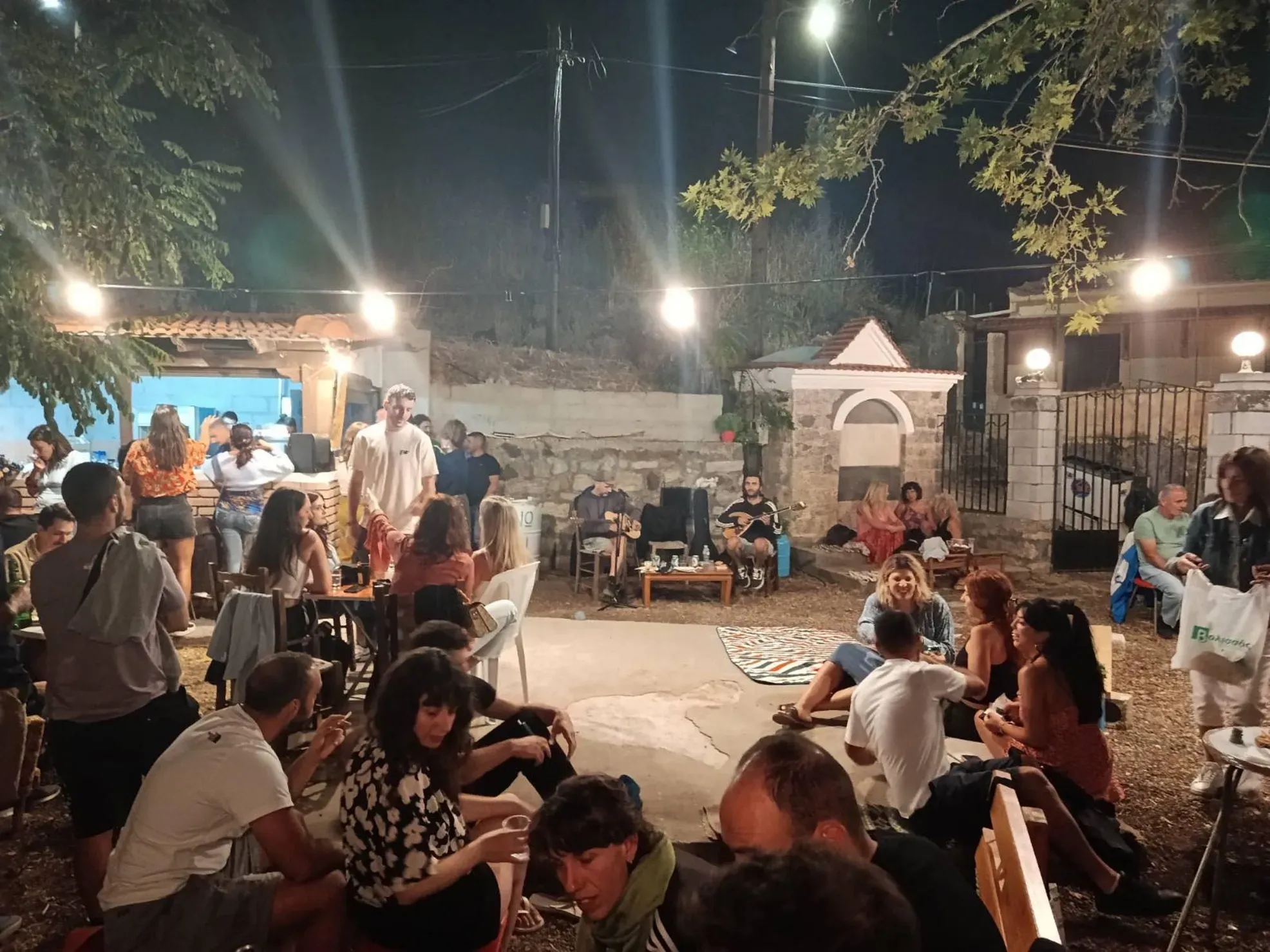
Activities also take place in the smaller square, Ano Vrysi. There you'll also find an informal "self-service" café: you can sit at one of the few little tables or relax in the hammock, help yourself from the available stock and leave whatever money you wish for its restocking.
But here's one of the village's small, delightful "mysteries": is this little square the Upper or maybe the Lower Spring? Don't expect an easy answer. If I've understood correctly, for the younger folk it's considered Ano Vrysi, while for the older ones it's Kato Vrysi. A small riddle, one of those that give a place extra character - not that Pispilounta needs it!
And when the instruments fall silent, the village returns to its natural rhythm. The intensity of the festival gives way once more to sweet calm. It's time for the traditional veggeres: those spontaneous, endless get-togethers in courtyards and on balconies, with relatives, friends and neighbors. Places where the door is open and the group grows without invitations.
Because in the end, hospitality isn't measured in comforts. It's measured in people. In a chair pulled up beside you, in a plate that fills without you asking, in a conversation that lasts a little longer than you expected, in a small handmade gift with your name on it that Mary will give you before you leave. And, ultimately, in that rare, precious feeling that, even for a few days, you found yourself in a place and lived it in such a way that it made you feel you belong there.
And if at times you feel like you're living your own "Groundhog Day" - something that, to be honest, I aimed for - and you've lost all touch with the present, once a week the sound of the Divine Liturgy arrives. Slipping into your sleep from the church loudspeakers, it reminds you it's Sunday morning. The priest, who arrives from a neighboring village - only, of course, during the periods when Pispilounta comes alive with people - ultimately achieves the most charming paradox: to bring you back, if only for a moment, down to earth.
Pispilounta, then, wasn't just a first stop. It was the necessary detox from the violent rhythms of daily life in the city and a pause before everything that would follow. A small digital disconnect, a return to the simple things and a reminder that the Aegean isn't only the popular destinations and the photos with blue waters. It's also its villages, its people, its scents, its festivals and the stories that aren't written in the guides.
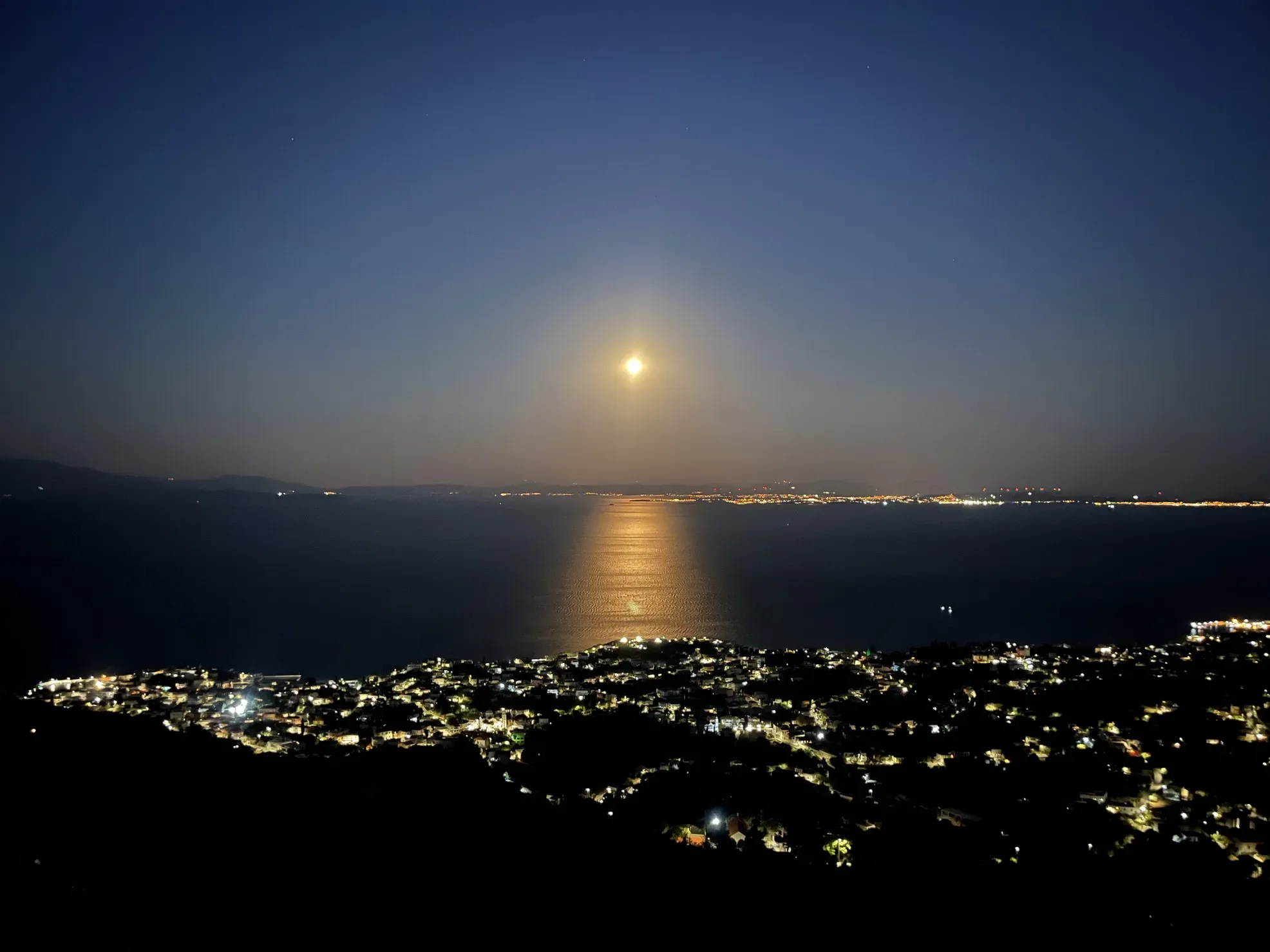
But the "carefree park" was only the beginning. After this deep, serene initiation in otherworldly Pispilounta, the compass pointed south, towards the port of Chios. Before you arrive, you'll wind through the bends of Aipos. There, if you catch the full moon rising over the Aegean, the panoramic view with the glowing moon bathing the coast will seal your memory forever. Next stop: the opposite shore and a completely different world.
Stop 2: Çeşme – From ancient Kysos to the cosmopolitan present
You board the boat and, after a short sea crossing of just thirty minutes, you arrive in a place that seems to run at a completely different intensity. Çeşme welcomes you with its modern marina, the imposing Genoese castle and a bustling seafront. But behind today's cosmopolitan image lies a history that's deep and inextricably tied to the Greek world of the Aegean.
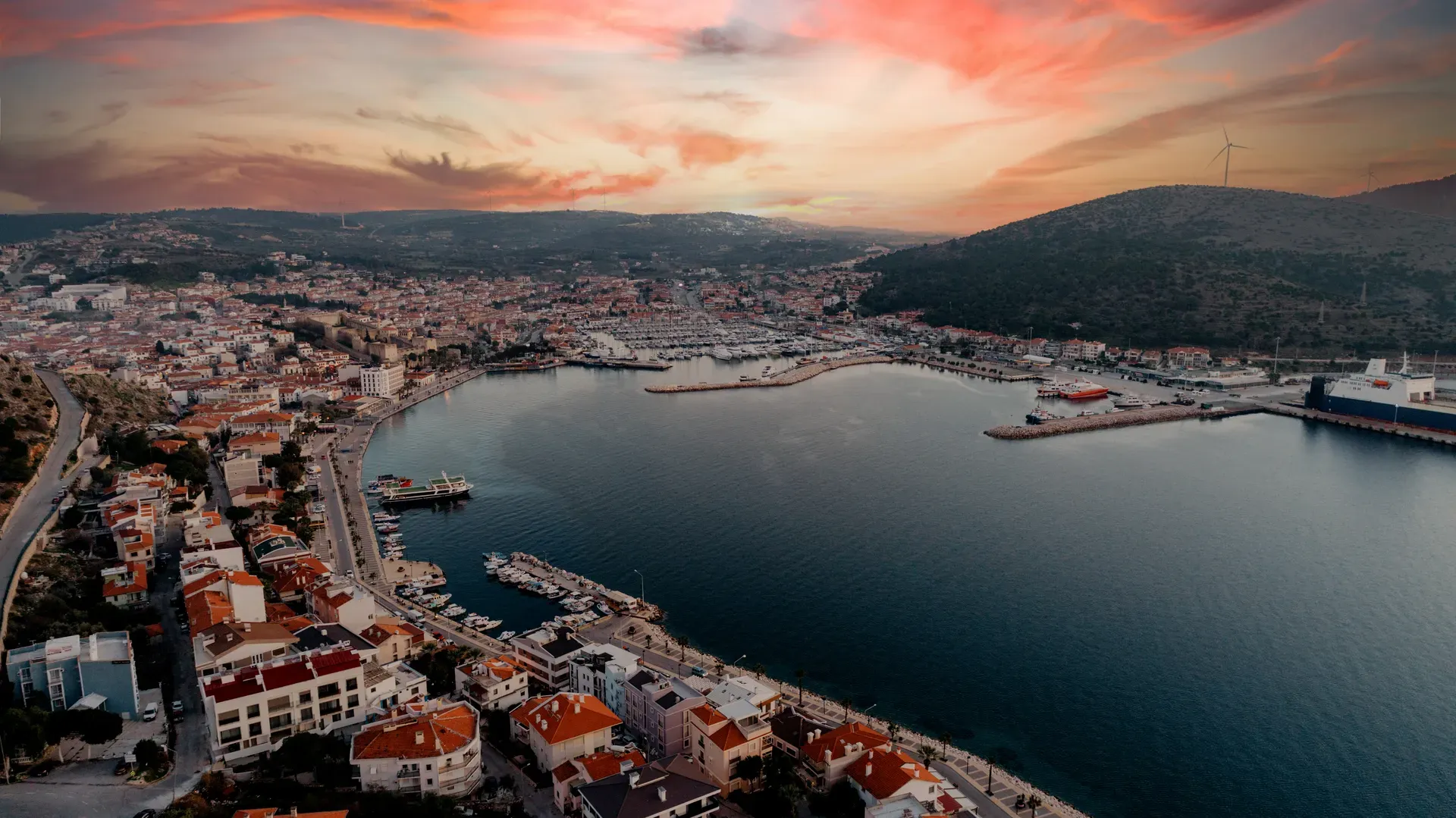
In antiquity the place was known as Kysos and served as the strategic port of ancient Erythrae, one of the twelve illustrious cities of the Ionian League. Its current name, which means "fountain", carries the echo of the old sailors who put in here to stock up on the famed, pure spring water — a small detail that seems to link yesterday to today.
Walking along the quay, with the silhouette of Chios across the water looking so close you could almost touch it, you realize that the distance between the two shores is geographically a breath, but the crossing is enough to change completely the rhythm, the time, and the whole feeling. It's as if the "air" around you changed - a different culture, a different energy, a different everyday life that, though so close, makes you feel that, within a few minutes, you've landed in another, entirely different, world.
Stop 3: From Çeşme to Bodrum - Toward ancient Halicarnassus
From there, the road to Bodrum - about a five-hour coach journey, depending on traffic and stops - unfolds yet another side of the Turkish Riviera. Today's cosmopolitan Bodrum is none other than ancient Halicarnassus - one of the most important cities of Caria, birthplace of the "father of History", Herodotus, and of the legendary queen Artemisia. In this very place once stood the famous Mausoleum of Halicarnassus, the monumental tomb of the ruler Mausolus, which rightfully earned a place among the Seven Wonders of the ancient world.
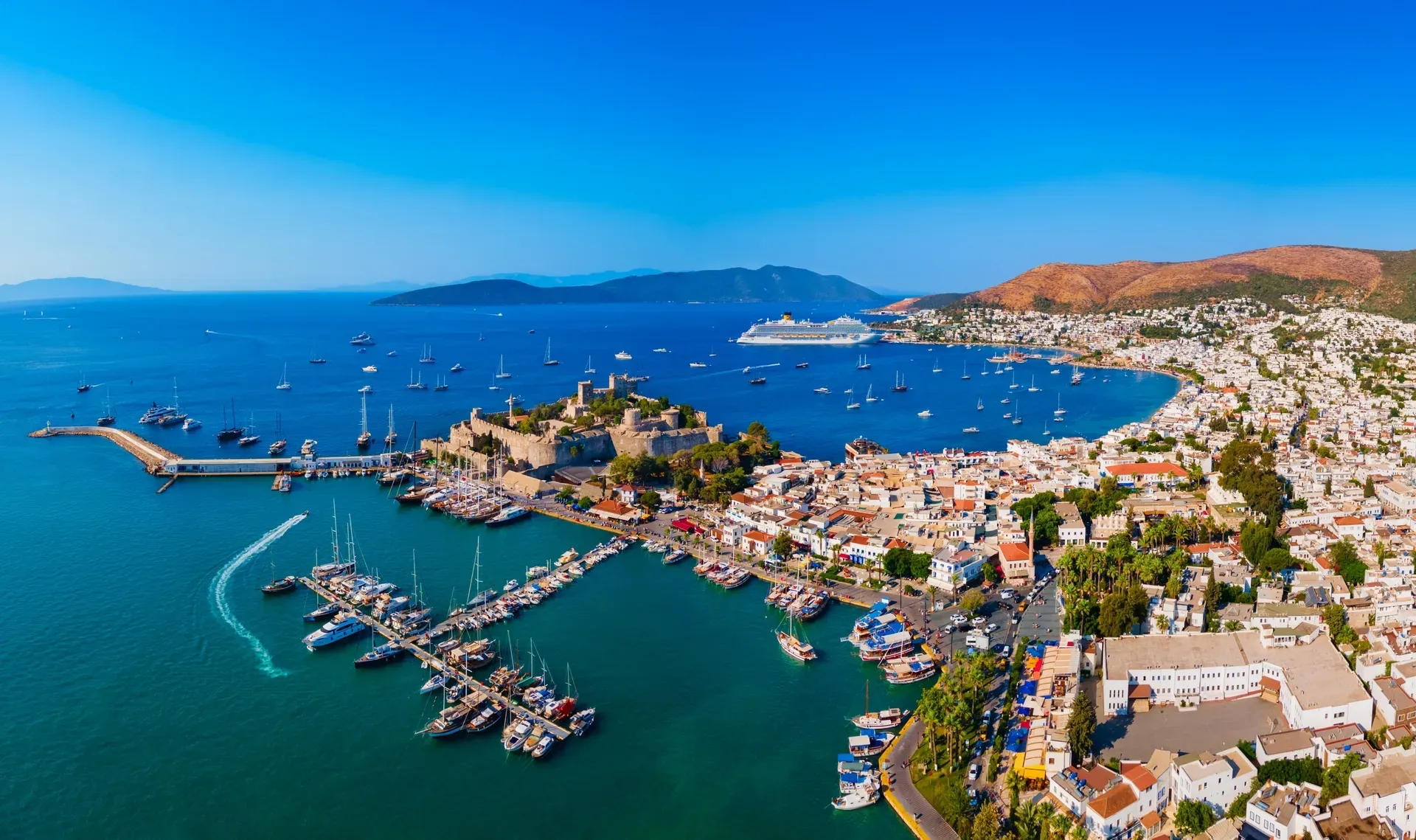
Even the imposing Castle of St. Peter, standing today like a stone guardian above the harbor, holds within its walls the relief of this journey. It was built by the Knights Hospitaller in the early 15th century, who, seeking ready and durable materials for their fortifications, used the marbles and reliefs from the already destroyed - due to an earthquake - ancient Mausoleum.
So, behind the luxurious superyachts, the exclusive beach clubs, the designer boutiques and the heady nightlife, you discover a city with countless faces. It's at once ancient, Greek, Carian, medieval - a beguiling palimpsest where one layer of history rests gently upon another.
After Pispilounta's unearthly calm, Çeşme and Bodrum feel like the curtain suddenly rises on a completely different, noisy performance. But that's exactly the point. A journey isn't only the destinations. It's the crackling contrast between them.
And yet, as much as the Asia Minor shore enchants you with its intensity and colors, as warm and genuine as the hospitality is, there's something invisible that pulls you back, to the other side. History itself, the one that joins and separates the two coasts, affects you in a subterranean way - especially if some of your ancestors' home was somewhere there.
Stop 4: Return to "our" Aegean: Bodrum - Kos - Kalymnos
The magic of this road trip is that you never stop changing scenes. From Bodrum's port, the speedboat brings you back into Greek waters, to Kos. And from there, via Mastichari, the next boat takes you to Kalymnos. Another change of scenery. And this time, the landscape starts to turn wilder. Barer. More Aegean.
Final destination: Skalia of Kalymnos – The awe of the blue
If Pispilounta was the mountain calm and Turkey's shores the cosmopolitan intensity, Skalia is the endless blue and awe. Driving toward the northwestern part of Kalymnos, the landscape grows ever wilder and more imposing. Sheer, bare cliffs - the very ones that have made Kalymnos a world-class destination for climbers - rise above the sea and the small seaside settlement.
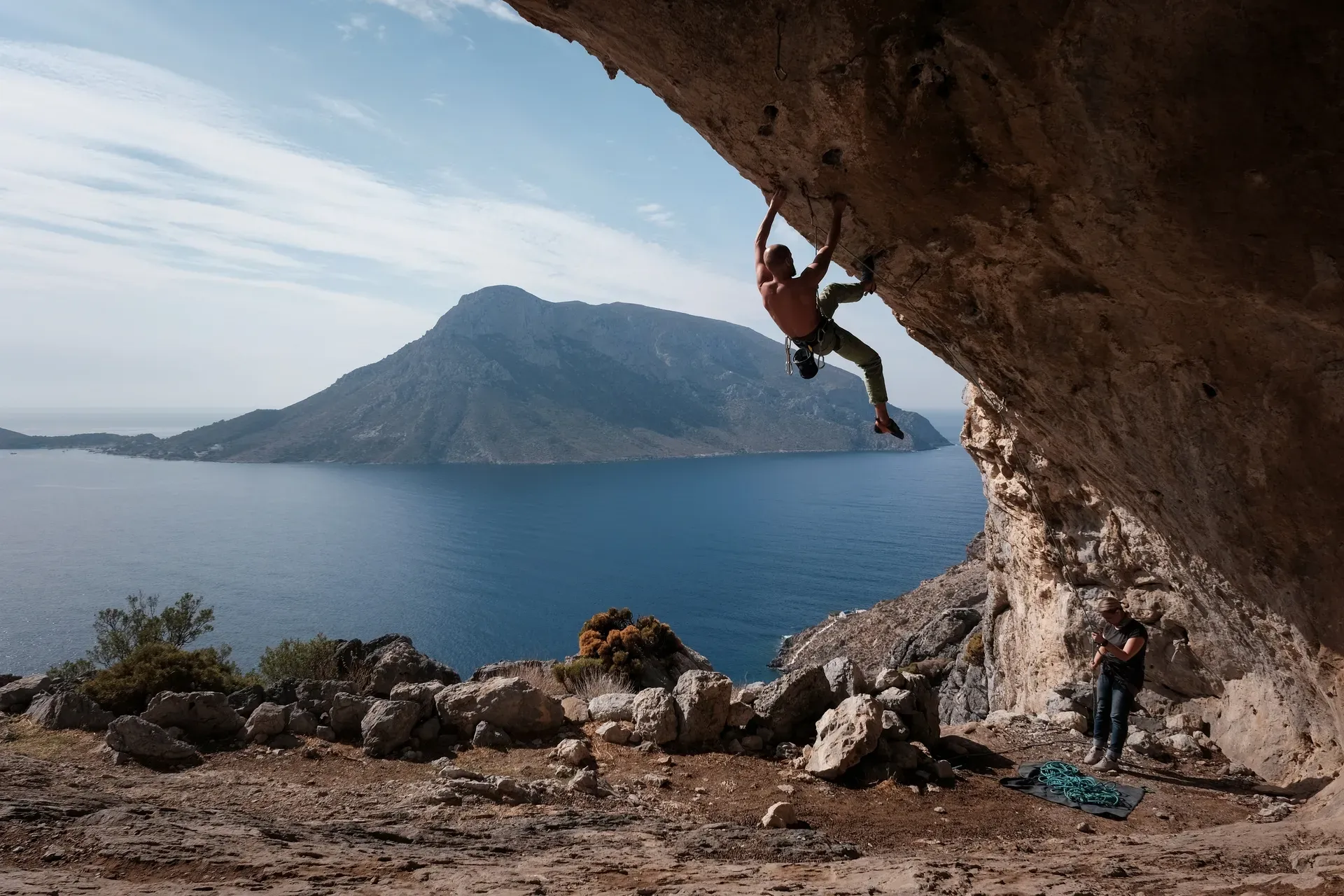
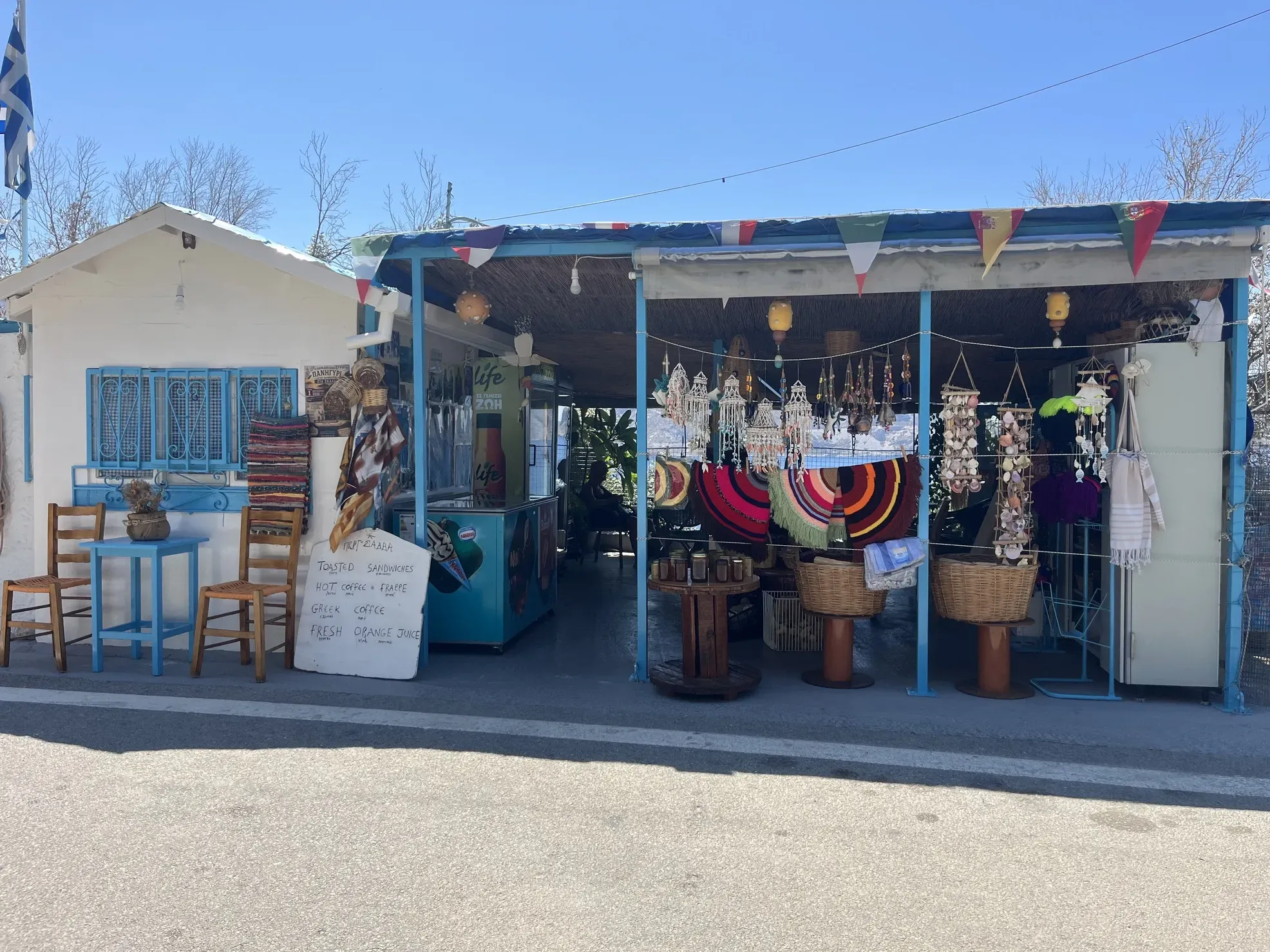
Skalia is built amphitheatrically and the view opens to Telendos and the little islet Kalavro. The village is, all in all, a single square (with visitors a few slightly different "mountaineers" - the goats you literally see everywhere) and a wonderful, multi-purpose little shop on the road (with souvenirs, supermarket goods, beach accessories - and which also operates as a café with a single table).


Somewhere here, the journey takes on its most personal dimension. We stayed in a secluded, beautiful little house - a true hidden refuge, nestled all alone within an estate of age-old trees. A place that doesn't just offer you tranquility and privacy, but, combined with the spellbinding view of the endless blue, gives you the conviction that you've discovered your own earthly paradise.
Your first thought is that you truly have no reason to go anywhere else. But, if as in my case, you haven't visited Kalymnos before, your cultural education demands you explore it, even a little. And I can't complain: Pothia rewards you.
The island's capital and port is a world entirely different from Skalia. Densely built, amphitheatrically arranged on the hills, with old mansions, colorful doors and windows and alleys climbing above the harbor, it still carries the history and wealth of the sponge-diving era.
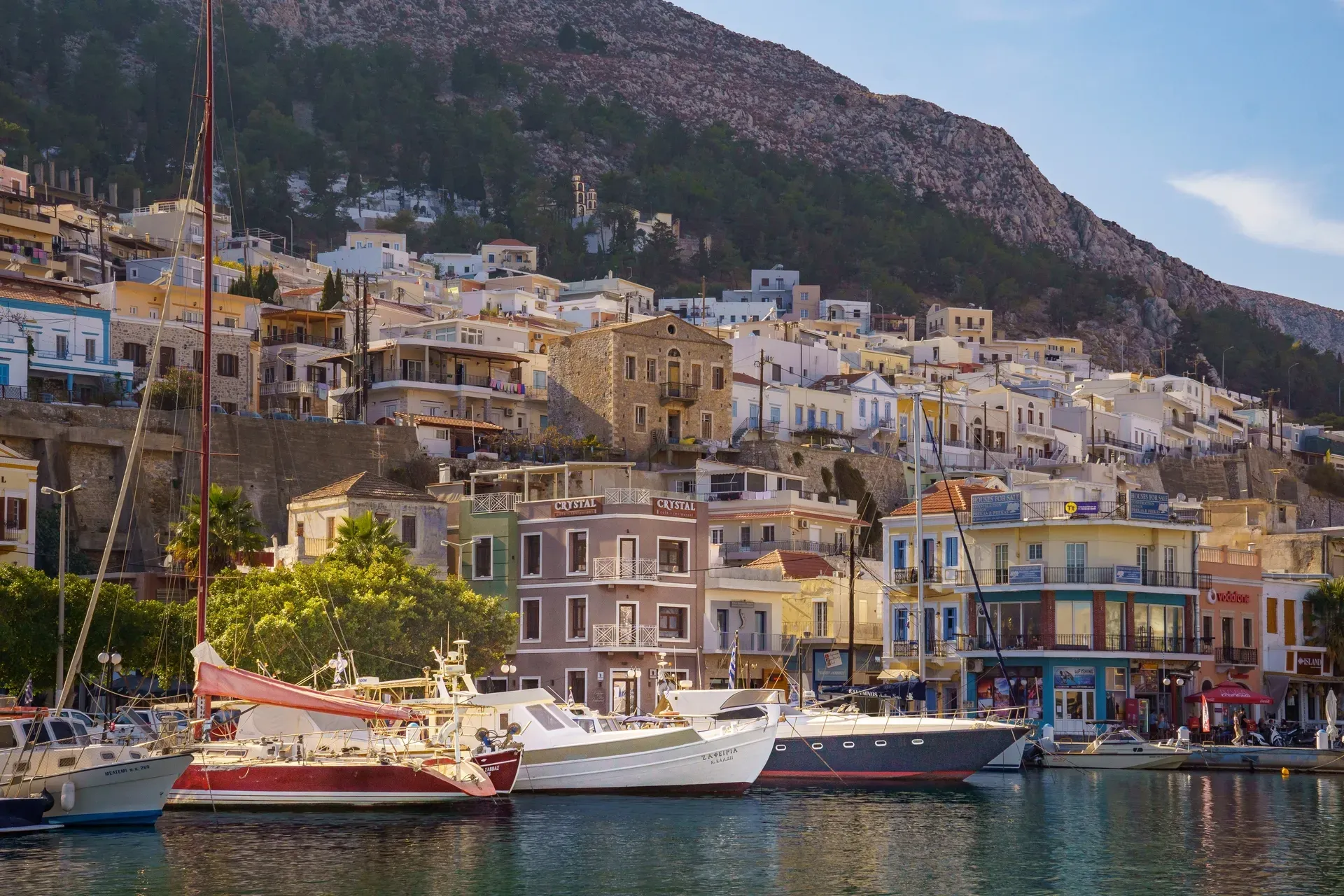
It's worth leaving the car for a while and walking the old neighborhoods, before heading back down to the sea. And of course, on Kalymnos a stroll isn't complete without food. Here the table fills with the true taste of the sea: crisp octopus fritters, charred octopus over coals, choice salted fish and meze that condense the whole Aegean into a single bite. Alongside you'll find the characteristic myrmizeli - the Kalymnian version of dakos, with barley rusk, tomato, olives, cheese and herbs. And if you're lucky and have local friends - like Chrysoula and Angelos - you'll also eat homemade "fylla", as they call dolmades in Kalymnos. A dish closely tied to the island's Sunday, family tradition.
And when it's time for something sweet, the stop at Michalaras in Pothia is almost essential. His galaktoboureko (made with rice flour - giving it that signature white, light and velvety texture) is one you don't remember merely as dessert, but as part of the island experience. If the rest of the company - Giannis, Stavros and Popi - happens to be at the table too, then, with the conversation flowing between lines of iambic fifteen-syllable verse, future professional and artistic plans, and traditional Kalymnian habits, you realize that the most precious souvenirs from an island aren't bought. They're the conversations you exchanged with hospitable, warm, radiant people who, though strangers until yesterday, from now on you'll recall as your own "company" on Kalymnos.
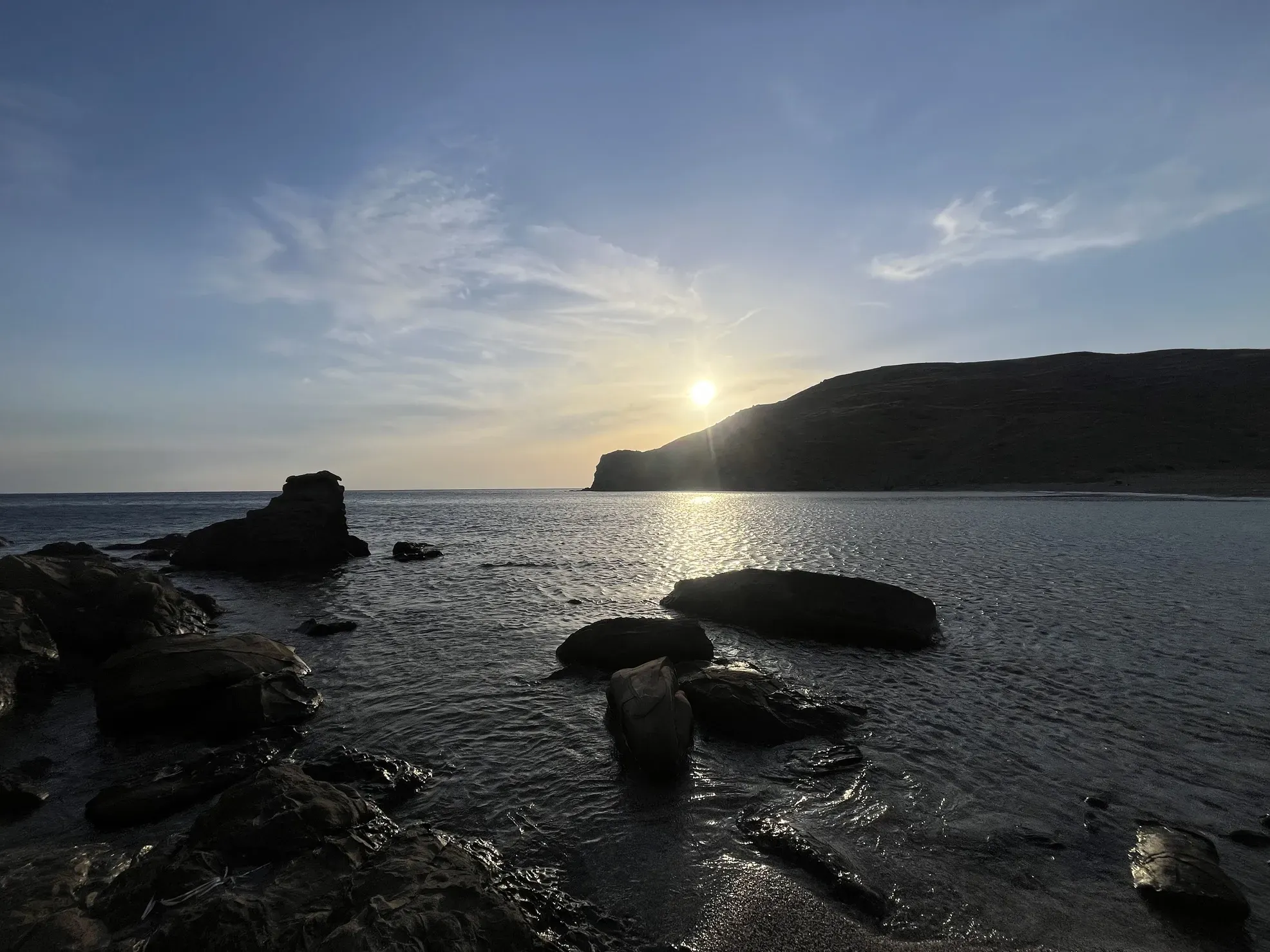
And of course there's Emporios. A small, remote and beautiful settlement even further than Skalia (to the north - on the pin of Kalymnos's map), with a gorgeous sheltered bay, spellbinding views and a sunset that makes you fall in love with the Aegean all over again, from the beginning - and this time, forever.
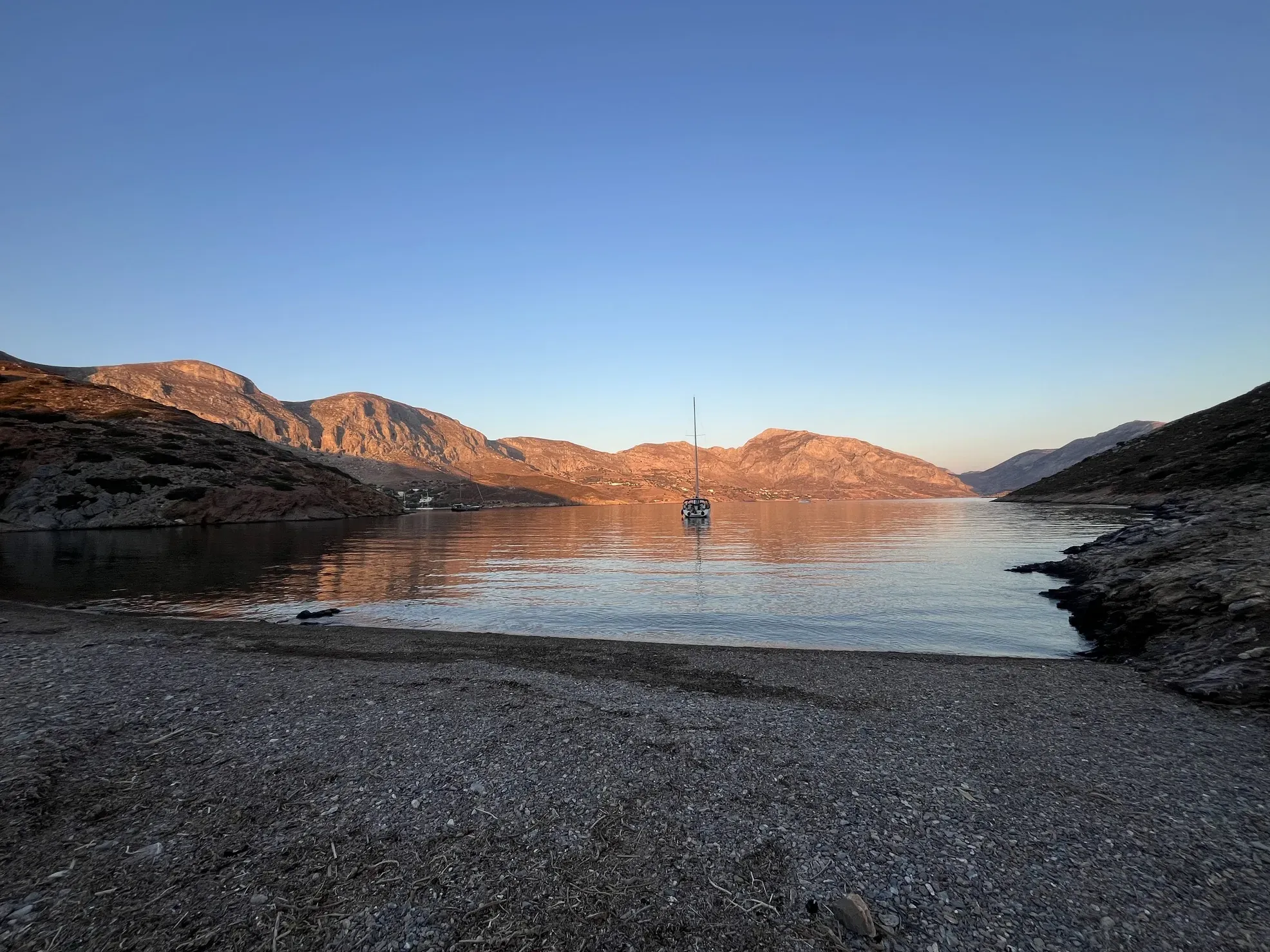
And forever, though, you'll keep returning to Skalia. Because it will never be enough... Perhaps because that's where the essence of this journey lies. It's not that Skalia has more things to do. It has fewer. And that's exactly the point. Sitting in the earthly paradise of Skalia, your gaze lost in the endless blue, you realize the beauty of this route.
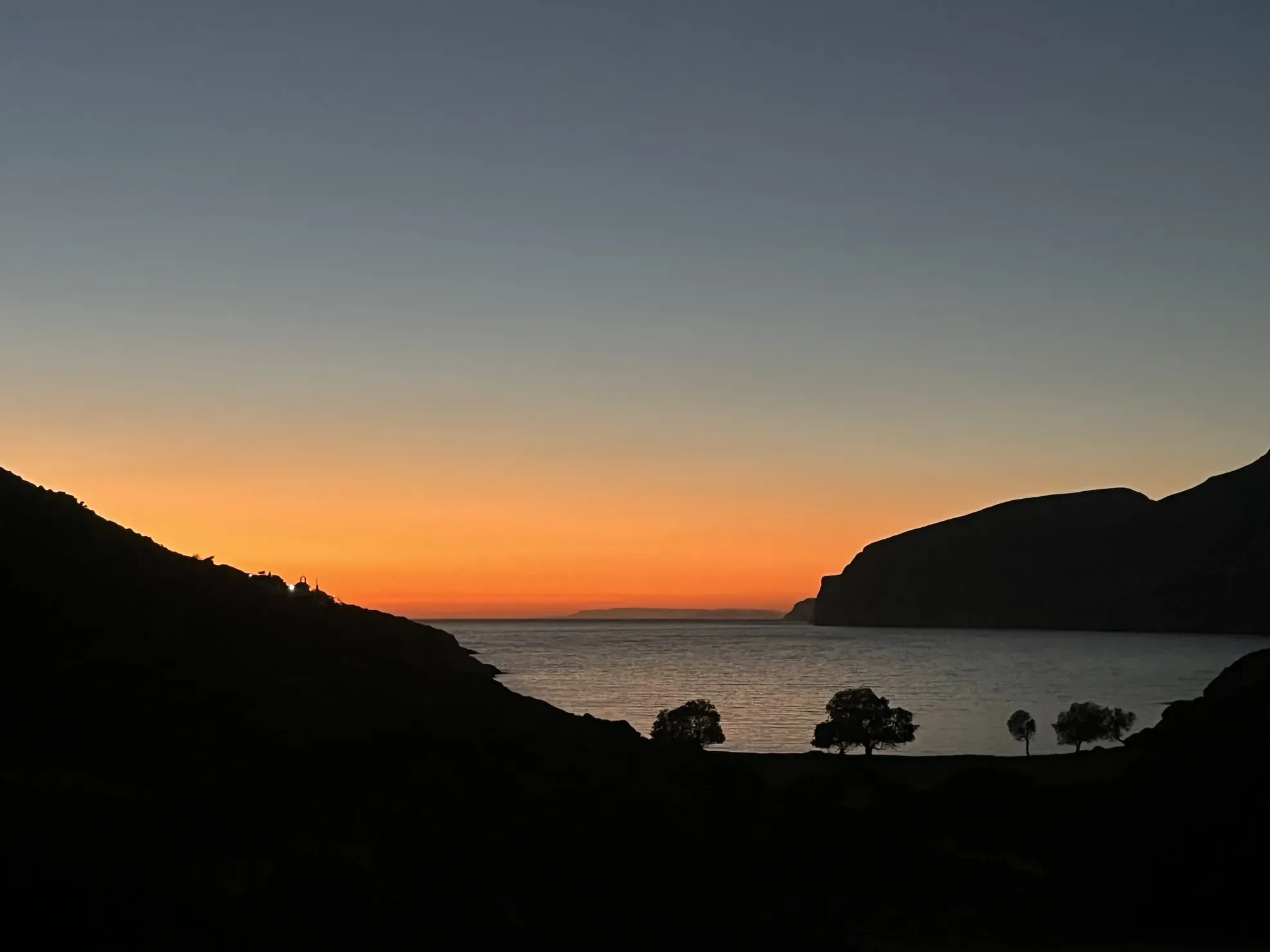
You started from a small village with no signal and no television, hidden in the mountains of Chios. You crossed through the bustling and cosmopolitan ports of the opposite shore. And you ended up in a small settlement on Kalymnos, between sheer cliffs, a bare landscape and the sea.
A journey that didn't count kilometers. It counted shifting emotions. And maybe that's the most beautiful thing a journey can offer you in the end: not to return simply to the same place. To come back a slightly different person.